

The M24 Sniper Rifle: a Brief History - Inside MDT
Throughout the Cold War, the U.S. Army primarily used semi-automatic sniper rifles. This chiefly includes the M1 Garand (through Korea and briefly into Vietnam) and the M21 (the accurized version of the M14). While semi-autos offered quick follow-up shots (which was a positive to Army Brass), these rifles were not inherently accurate weapons. The rifles' wood stocks morphed under varying climate conditions, all while their harsh operating systems made it difficult to build and maintain accurate rifles. It simply wasn't feasible to maintain long-term.
The move away from these rifles came about because of the increasingly important role snipers were playing on the battlefield and the realization that future conflicts may be in flat, open desert terrain rather than the rolling hills and thick forests of Europe (the Cold War was ending while tensions escalated in the Middle East). Solicitation for a new rifle hit gun manufacturers in 1985, and by 1988, the Remington 700 was selected and named M24. Of course, it was always going to be the Remington 700. The Marine Corps already used the 700 as the base for the M40, which was widely popular and held a strong reputation (although the M40 was built in Remington's Custom Shop, while the Army's M24 came off the production line before modification).
More: The M40 Rifle: a Brief History
Like the M40, the M24 was a system (specifically the sniper weapon system or SWS) and included the optic, mounts, and ancillary hardware to support the rifle. To reiterate from previous articles, this was a big deal. A sniper, by nature, works independently or in small groups and, therefore, needs to be self-sustainable. The system comprises the Leupold Mk IV M3 10x42 scope, Mk IV rings, OK Weber iron sights, Harris bipod, cleaning kit, tools, emergency replacement parts, M1907 sling, drag bag, manual, and a heavy-duty case. With this, the sniper could service the rifle in the field, which was difficult with the M21 without the skills and tools of a trained armorer nearby.

M24 Built by GA Precision. Want an M24? Head on over to the GA Precision website, and buy one.
As for the rifle itself, it is chambered in 7.62x51mm NATO (or 308 Winchester) and is fed from an internal box magazine that holds five rounds. Moreover, the barrel is 24" and has a unique 1:11.25" twist rate (a preferred twist to stabilize the M118LR ammunition). All metal surfaces of the M24 feature a powder-coated "Rem-Tuff" finish, and the synthetic stock is coated with an epoxy-based black coating that is both non-reflective and non-slip. The overall weight of an unloaded M24 without the scope is about 13 lbs. Scoped and loaded, the M24 weighs 15 lbs. Interestingly, while the M40 uses a short-action, the M24 has a long-action receiver. Contradictory reports state that the reason was either that the original rifle may have been chambered for M72—30-06 match ammunition or that the rifle had the flexibility to convert to other calibers, such as the 300 Winchester Magnum. I find the latter to be more plausible. Unfortunately, the long action could induce feeding issues if the bolt wasn't properly worked to the rear or the ammunition wasn't seated properly in the internal (and later, detachable) magazine.
The stock on the rifle is the most interesting. Made by H-S Precision, the stock is built from Kevlar-reinforced fiberglass that is ambidextrous with both left and right-hand palm swells and a fixed comb height. The action rests in an aluminum bedding block that free-floats the barrel. Additionally, the forend is flat like popular bench rest rifles of the period, which helps with balance and rearward recoil, mainly when shooting off bags or flat support. One unique feature of the M24 over M40 is its user-adjustable stock for length of pull. The stock can be extended from 12" to 14" by loosening a knurled nut and moving the buttpad to the user's desired location. One popular modification was for snipers to "build" their cheek weld by using foam from bed mats and 100mph tape to adhere everything together.
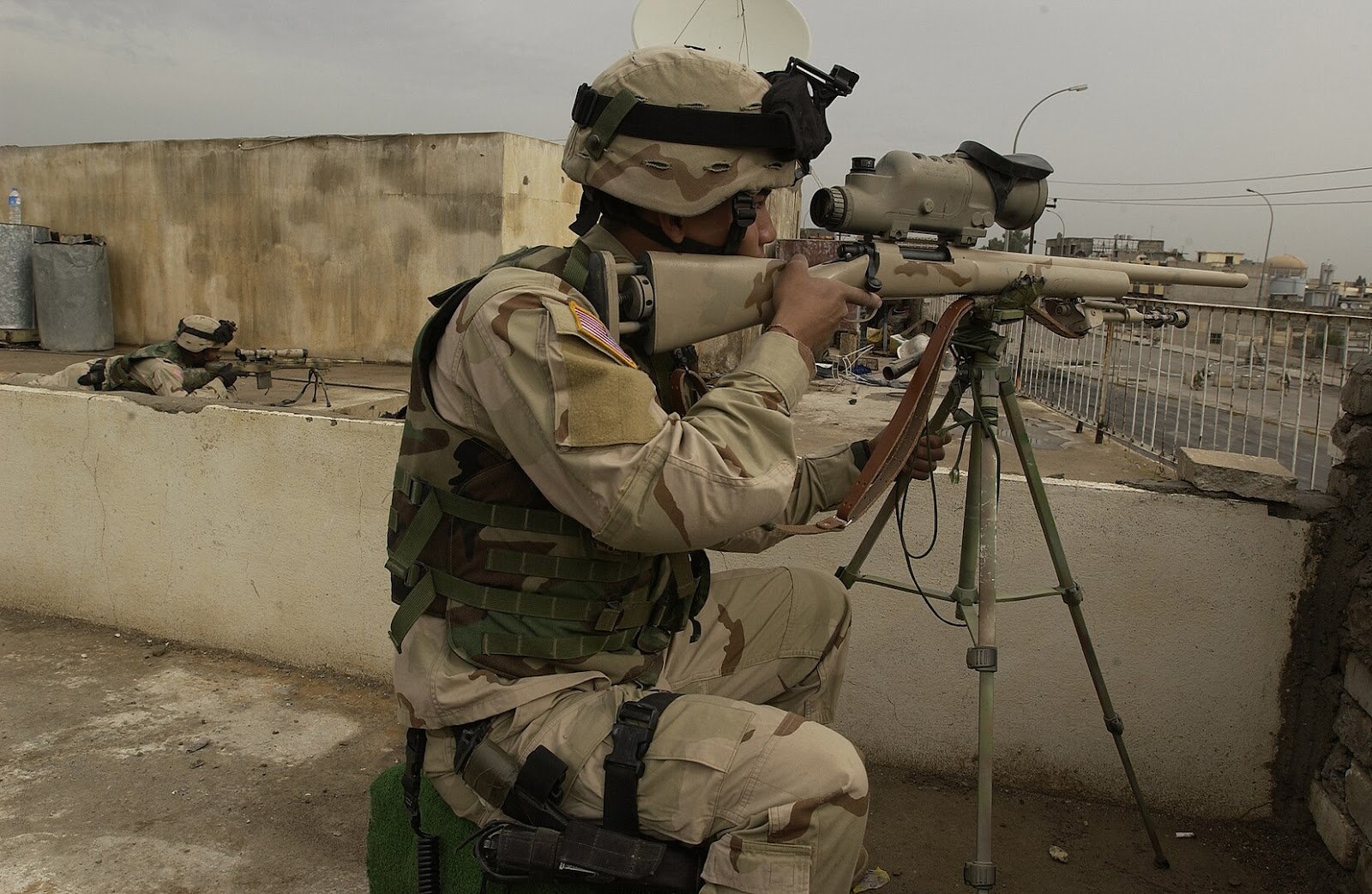
M24 and M21 in Iraq.
Another unique feature of the M24 is its inclusion of iron sights. This seems peculiar today, but optics in the late 1980s, even good ones, were not as proven and established as they are today. Back-up sights were thought necessary as a last resort—how often they were used is anybody's guess. The iron sight attaches via a front dovetail and a rear plate. It features a graduated peep system that's adjustable for windage and elevation.
In an American Rifleman article titled "The Remington M24 Sniper Weapon System," writer Michael Humphries speaks with former NRA Secretary Edward J Land Jr. (yes, the same Capt. Land who helped spearhead the Marine Corps sniper program during the Vietnam War) about the M24. Land stated, "Frankly, you should only be firing one or two shots, and semi autos throw the brass out automatically. That flash of brass could give your position away. Although precision accuracy is important, it is still subordinate to maintaining zero. I would rather have a rifle that shoots three MOA and keeps it zero than a one MOA rifle whose point of impact shifts." In this context, Land is speaking of the inconsistencies of the M21 sniper rifle. While it was accurate enough, its harsh operating system and lackluster optic mounting system caused zero shifts. The problems usually could not be fixed in the field by a soldier, but the careful eye of a trained armorer was needed. Later in the article, Land continues his thoughts on the M24, "Although this one is still heavier than I would like to see, it comes a lot closer to a realistic concept of what these rifles [sniper rifles] should be."
More: M21 Rifle The Legacy of Army Snipers
Like the M40, the M24 is undoubtedly still in use, even after the acceptance of the M2010 upgrade and other sniper rifles. The M24 has a proven track record, a robust design, and plenty of clout. That said, it's a rifle from the 1980s. Technology and trends change. The advancement of the precision rifle world in the past decades has exceeded the advancements of any other period (except maybe for the invention of rifling and the minié ball). We know more about how to shoot small targets far away.

US Army Sniper Team in Iraq. Note the iron sights on the M24.
Another interesting note about the M24 is the local acceptance of the M24A2. As mentioned above, the M24 was a bit dated at the start of GWOT (Global War on Terror). The M24A2 was a program to modernize the weapon system. However, this version was never widely purchased by Big Army. Still, several units on deployment orders had their M24s converted to the A2 standard. Updates included:
- An adjustable comb.
- Variable power optic (Leupold Mark IV M3 3.5-10X optic with mil-dot reticle).
- Detachable 5-round box magazine.
- Forward rail to mount night vision and IR lights/lasers (Badger Ordnance MARS Rail).
- The ability to attach a suppressor (OPS INC).
While this was a marked improvement over its predecessor, the M24A2 program was dissolved in 2010 as the Army frowned upon "improved" rifles that were not officially designated. This gave rise to the XM2010 program (which will be covered in the future).
The M24 is an iconic rifle. Its use by the Army and Law Enforcement Agencies around the country has cemented it on the Mt. Rushmore of U.S. Sniper Rifles. Because of the rifle's distribution, many are familiar with it. Like the M40, many have attempted to copy or clone the weapon for their collections. As we inch closer in this series to more modern sniper rifles, the M24 is the genesis for future rifle programs.
HISTORY AND EDITORIAL
- The M40 Rifle: a Brief History
- M21 Rifle: The Legacy of Army Snipers
- Famous Sharpshooters: Timothy Murphy
- The Ethical Shot
- Coyote School - Deception
- Coyote School - The Easy Path
- Coyote School - After The Storm
- Coyote School - Death And Rebirth
- A Journey Of Practice
- Starting Over
- Race To The Top
ABOUT THE AUTHOR
I have worked in the firearms industry for 11 years and counting. What started as a part-time job during undergrad has become a career. In that time, I have been lucky to work with some incredible people and companies. I also completed a Master of Arts in History from Cleveland State University. When I am not shooting, reloading, or working on my firearms, I am reading, writing, and tinkering with Legos.
Related Posts

Flat-Shooting Cartridges: Why Do They Matter, and What Are the Drawbacks?

Impact Shooting: Tikka T3x 300 WSM Hunting Rifle Build

AREA 419 | Law Enforcement Sniper Systems—Build Breakdown

Mounting a Rifle Scope? Avoid These 5 Mistakes

Ultimate Reloader: Bergara Competition Elite - 6mm Dasher at 1 Mile!

Beyond Rifles and Optics: Four Predator Hunting Essentials

Impact Shooting: 7 Sherman Short Magnum at 1 Kilometer


