

The M40 Rifle: a Brief History - Inside MDT
The M40 rifle. It is ubiquitous in the realm of firearms history. Its birth coincided with a need for a precision rifle in the steaming jungles of Vietnam, and its legacy was built by those who relied on its performance. Its accuracy, reliability, and endurance have birthed a generation of precision rifles that ultimately pay homage to its design. While an in-depth history is comprehensive, this exercise is brief. But it provides context and understanding of the history of the M40 rifle in Vietnam. To quote Thom Pinto and his opening on Tales of the Gun, "The gun has played a critical role in history. An invention that has been praised and denounced served heroes and villains alike and carries with it moral responsibility. To understand the gun is to better understand history."
THE COLD WAR WARMS: VIETNAM
The United States entered Vietnam as a measure to preserve Democracy and fend off a growing Communist threat. The war, much like the recent conflicts in Iraq and Afghanistan, was politically driven, with actors at a national level moving pawns on a chessboard. However, this was a new kind of war for the United States, fought against an unconventional enemy. New military stratagems were emerging, including rapidly growing intelligence and special operations apparatus. Included in this are specially trained hunters—snipers.
This wasn't the first time in United States history that snipers were utilized. Marksmen of various kinds have been used since the Revolutionary War through the Korean conflict. However, they were never a permanent peacetime unit like we see following Vietnam. They were temporary, which meant consistent curriculum and armaments were not properly maintained. As warfare was changing, so was the role of the sniper.
More: Famous Sharpshooters: Timothy Murphy
That brings us to the M40 rifle and its place in history. Early in the Vietnam War, military leaders and strategists quickly realized there was a need for snipers. For one, the United States could not deliver accurate small-arms fire at a distance. The dense jungles and their unconventional enemy proved difficult for a standard military (for further context, see Embers of War: The Fall of an Empire and the Making of America's Vietnam by Fredrik Logevall). The North Vietnamese Army (NVA) knew this, and early in the war, they exploited this fact. The NVA benefitted from utilizing the Soviet Union's WWII sniper training doctrine and rifles to engage American troops from a distance. They were the disruptors.

Winchester Model 70 in Vietnam.
American military brass soon realized they needed disruptors of their own. The United States needed specially trained soldiers to run very specific missions. These missions involved the gathering of information and intelligence, the disruption of supply chains, the protection of military units, and, in some cases, the elimination of high-value targets. The problem was that the sniper-specific training needed to be more robust and ad hoc. The rifle situation was worse. Early sniper units relied on the rifles and training developed during World War II. A new rifle and training regime was needed.
The training came first—largely due to the efforts of Major Jim Land (and an in-depth discussion of this would require another article entirely). Major Land was the man responsible for altering the Marine Corps' emphasis on sniping. He established the first organized sniper training school in 1961 in Hawai'i. This laid the groundwork for the creation of additional sniper schools in-country to be used by the 1st and 3rd Marine Divisions. Ultimately, this was the predecessor to Modern-Day sniper instruction.
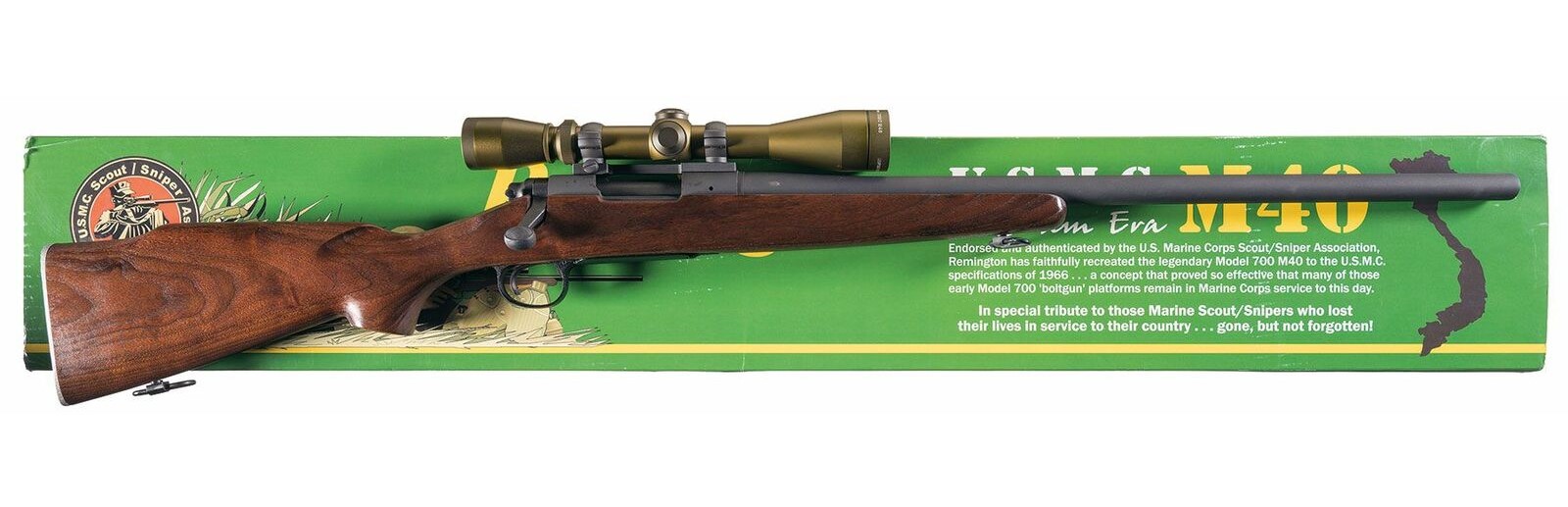
Remington Reproduction M40.
THE M40 RIFLE
Leftover rifles from World War II and Korea, which included the M1C/M1D Garand and modified 1903A4 Springfield rifles, no longer met the grueling demands of the United States Marine Corps. Early in the war, sniper units pillaged the inventories of marksmanship units for Winchester Model 70 target rifles. While the M70 was an excellent rifle, its 30-06 chambering and the rifle's inherent engineering changes from Winchester made it a logistical nightmare (at any point, three different designs of the Model 70 were being utilized, with parts interchangeability a major issue). However, the rifle had its supporters (Marine Corps Scout Sniper Carlos Hathcock. His story was made famous by the book Marine Sniper: 93 Confirmed Kills). But in 1965, Marine Headquarters instructed the Quantico Marine Schools Weapons Training Battalion to issue verbal orders to the Marksmanship Training Unit to procure a rifle, telescopic sight, and mount suitable for use by snipers.
More: Why All The Hate For The 30-06
Soon after the initial order, a February 9, 1966, response to the Marine Corps Commandant, the officer in charge of the Marksmanship Training Unit stated, "The indicated urgency for an early recommendation dictated that evaluation be limited to presently available commercial items." A military rifle hadn't yet been developed in the United States for specific use as a Sniper Rifle. Thankfully, the United States has a rich tradition of rifle building.
In that same response, a sub-section titled "Self-Imposed Assumptions" listed several rifle requirements. "…the selected sniper system to use the standard 7.62mm ammunition and be simple, sturdy, and explainable with minimal instruction." Five rifles were tested. This included the Winchester Model 70, the Harrington and Richardson Ultra-Rifle, and three models from Remington. In addition, seven different telescopic sights were tested. The Model 70 was quickly disqualified as it was chambered in 30-06. The Ultra-Rifle was also discarded because its construction used several manufacturers' components. Remington's other rifles (Model 600 and 700 ADL) were deemed "too light" for military sniping operations. Only the legendary Remington 40X (or 700-40X) passed all requirements and testing.
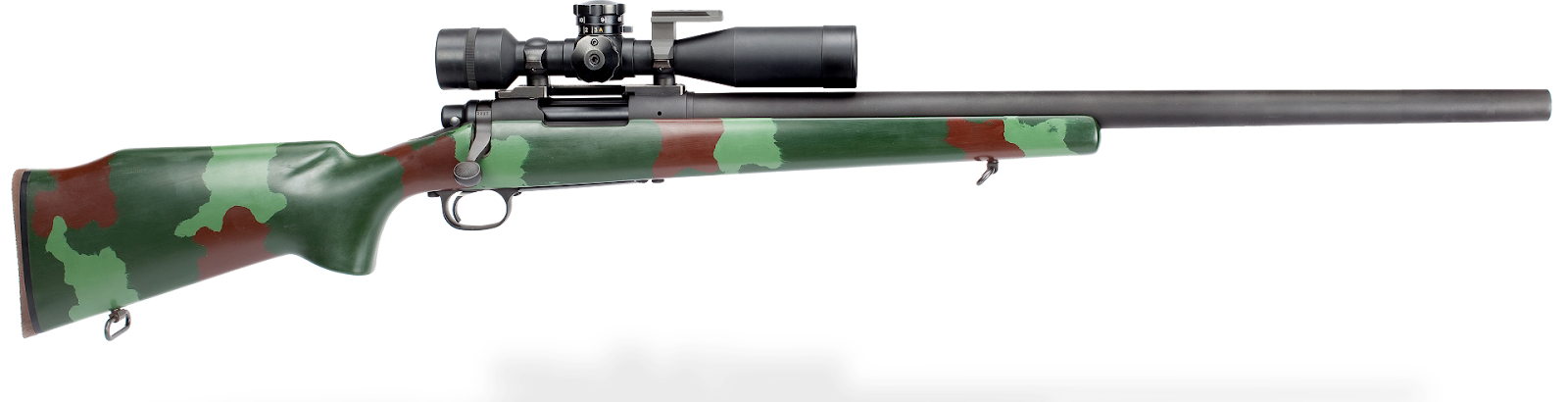
M40A1. Reproduction from GA Precision. Photo Courtesy of GA Precision.
Along with rifle and optic requirements, the MTU letter's final paragraph added, "Thus, along with the M40 sniper rifles, came special ammunition manufactured for the marksmen's use on the range and the battlefield." What this line presents is a form of unification in a specific weapons system. For the Marines and the rest of the U.S. Military, this was the first time that a precision rifle was looked at as a system. Rifle, optic, case, ammunition, sling, and all ancillary gear and components were streamlined to create one system. (As for the ammo, this was the birth of the famed M118 7.62X51mm Match ammo).
The Marines contracted for an initial batch of 700 rifles from Remington (although over 900 were delivered). They were shipped in plastic cases designed to house the entirety of the system. An important part of that early sniper system was the Redfield Accu-Range scope. Its 3-9 magnification range and compact size were state-of-the-art in 1966. Doubling down on its uniqueness was a reticle that could be used to range targets out to 600 yards. Holding the package together were mounts that were near facsimiles of those used on the 1903A4 Springfield rifle. One important note on the variance between the prototype and the production M40 rifle was the inclusion of a clip-slotted bridge on the 40-X receiver. The slot allowed for the quick loading of ammunition via stripper clips. All production model M40 rifles were built on the standard Remington 700 short-action with no slot for stripper clips.
THE M40(r) EVOLUTION
The M40 proved to be an accurate rifle. They were quickly implemented into the harsh combat in Vietnam, and Marine Snipers were confidently able to engage the NVA and VC (Viet Cong). However, Vietnam was a bit different than Quantico, VA, or even Hawai'i. Early rifles shot well but weren't necessarily ideal for the humid jungles. Namely, the wooden stock was the culprit for questionable serviceability. Vietnam is Tropical—it rains a lot. Wood, such as the stock of an M40 rifle, reacts to moisture. High humidity causes the wood stock to expand and contract. Conversely, the swollen wood causes pressure points along the barrel, affecting accuracy. The only solution is to remove the barreled action from the stock and sand down the high spots—an annoyance, to say the least. Additionally, the harsh conditions sidelined many of the original contracted rifles. Rusting, cracked optics, broken triggers, and the lack of parts led to the rifle's evolution into the M40A1 in 1973. Modifications to the M40 included welding the recoil lug and internal magazine box to create a solid one-piece body. Next, the original aluminum trigger guard and magazine floorplate were replaced with a modified steel one borrowed from Model 70 rifles. The chrome-moly barrels that were prone to rusting were replaced with Atkinson stainless steel tubes finished in black oxide. Finally, the dated wood stock was replaced by a fiberglass one from McMillan and given an iconic multicam finish. While the modifications were significant updates over its predecessor, the gun came in at 12 lbs., 3 lbs. heavier than the M40. Fielded from the early 1970s and into the 2000s, the M40A1 is the Marine Corps' longest-serving sniper rifle.
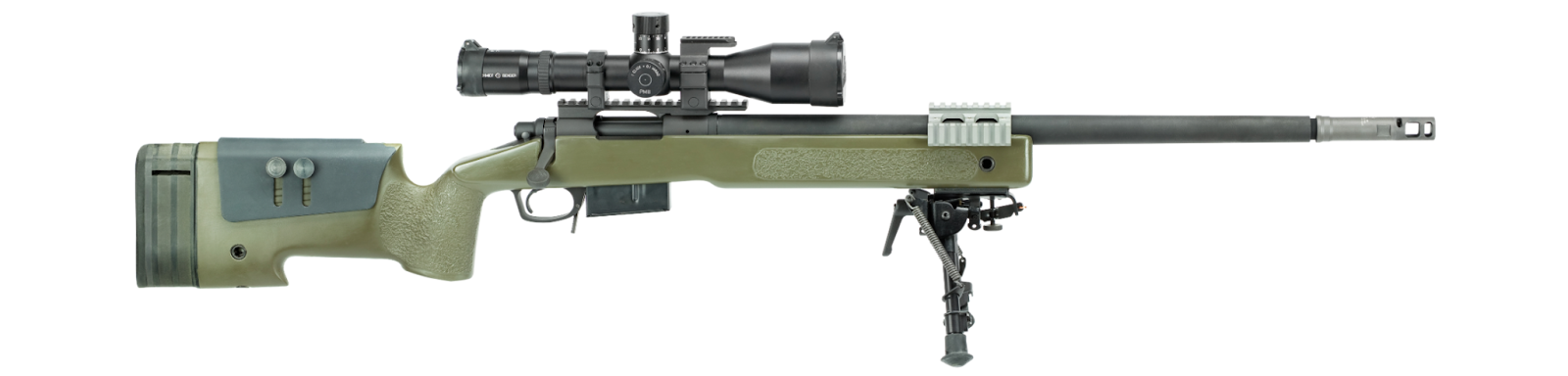
M40A5. Reproduction from GA Precision. Photo Courtesy of GA Precision.
M40 LEGACY
The M40 has longevity. Even with a plethora of options, the Marines have stuck with the M40 (and its offspring) until very recent history. It's a rifle that is ubiquitous and synonymous with the Marines. David Merrill of Recoil Magazine wrote, "To be certain, warfare pushes and drives innovation through sheer necessity—not only in the development of the weapons themselves but how they're deployed and outfitted." That can be looked at as a summary of the Vietnam conflict. It was a change in warfare not dissimilar to The Great War. The Marine Corps Sniper and their M40 rifles altered the battlefield. And, whether fair or not, the M40 is the precision rifle that all others are compared to.
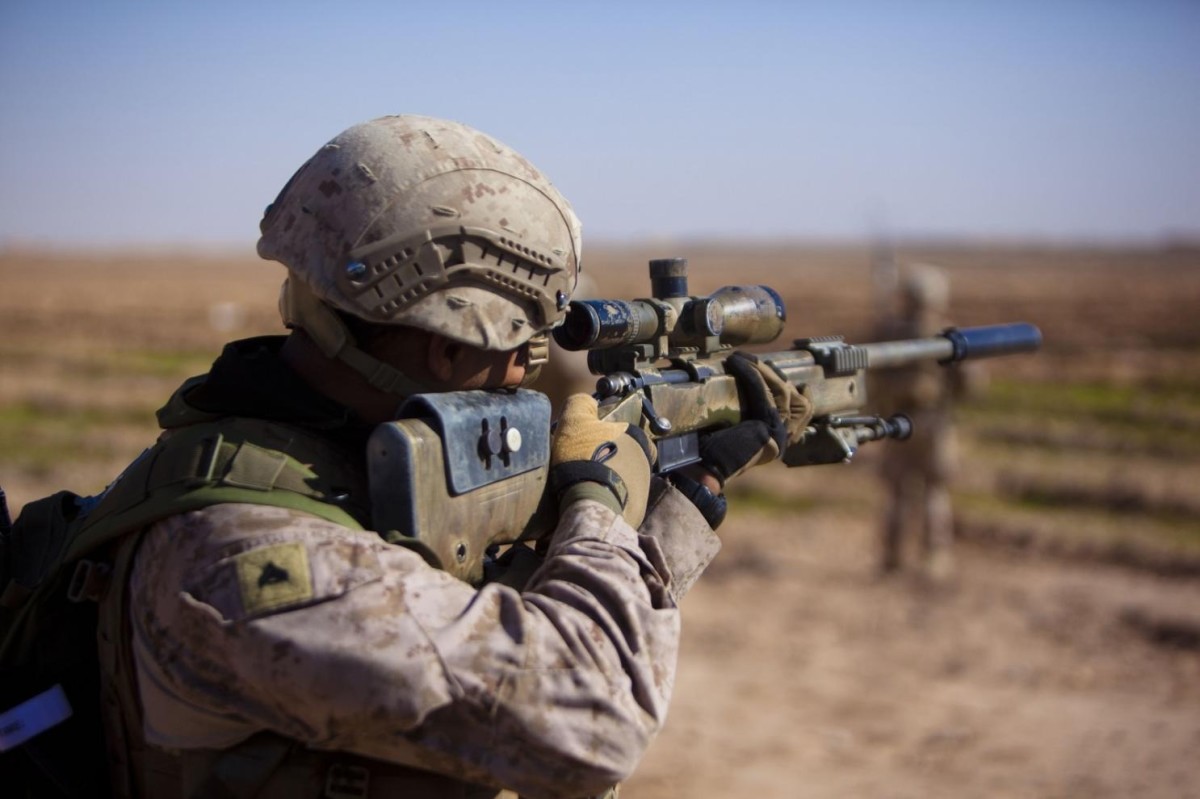
M40A5 in the wild.
HISTORY AND EDITORIAL
- Famous Sharpshooters: Timothy Murphy
- The Ethical Shot
- Coyote School - Deception
- Coyote School - The Easy Path
- Coyote School - After The Storm
- Coyote School - Death And Rebirth
- A Journey Of Practice
- Starting Over
- Race To The Top
ABOUT THE AUTHOR
I have worked in the firearms industry for 11 years and counting. What started as a part-time job during undergrad has become a career. In that time, I have been lucky to work with some incredible people and companies. I also completed a Master of Arts in History from Cleveland State University. When I am not shooting, reloading, or working on my firearms, I am reading, writing, and tinkering with Legos.
Related Posts

Flat-Shooting Cartridges: Why Do They Matter, and What Are the Drawbacks?

Impact Shooting: Tikka T3x 300 WSM Hunting Rifle Build

AREA 419 | Law Enforcement Sniper Systems—Build Breakdown

Mounting a Rifle Scope? Avoid These 5 Mistakes

Ultimate Reloader: Bergara Competition Elite - 6mm Dasher at 1 Mile!

Beyond Rifles and Optics: Four Predator Hunting Essentials

Impact Shooting: 7 Sherman Short Magnum at 1 Kilometer


