

Picatinny Rails Vs Weaver Rails - Inside MDT
I'm old enough to remember when rifles didn't have rails for mounting optics. If that seems like it might have been confusing, let me assure you, it was. Every manufacturer had their own system for mounting scopes, and there wasn't much interchangeability. Names like Weaver, Redfield, Leupold, Conetrol, and Bausch and Lomb dominated the optics mounting world. Some of their products are now collector items, pushed out of popular use by the standardization of rail mounting systems we now take largely for granted.
WEAVER RAILS
Developed in the mid-70s by William Weaver, his system for mounting optics to rifles was once the closest thing to a standardized system. While the Weaver company did a fine job of keeping their tolerances tight there were no published specifications. As a result, products made by other manufacturers and intended to work with Weaver's system varied widely. It's still common to run into the Weaver optic mounting system today. A dead giveaway to the fact a rail is built for the Weaver system are rounded slots in the rail. However, square slots show up regularly as well. Regardless of shape, these slots are about 0.14-0.16 inches wide, and there are often only two slots on a full-length rail. Weaver rails are also commonly seen as two short sections which mount separately. There are no specifications for the distance between slots.The Weaver system became the most popular of those available at the time, and even the military tried using it, but with limited success.
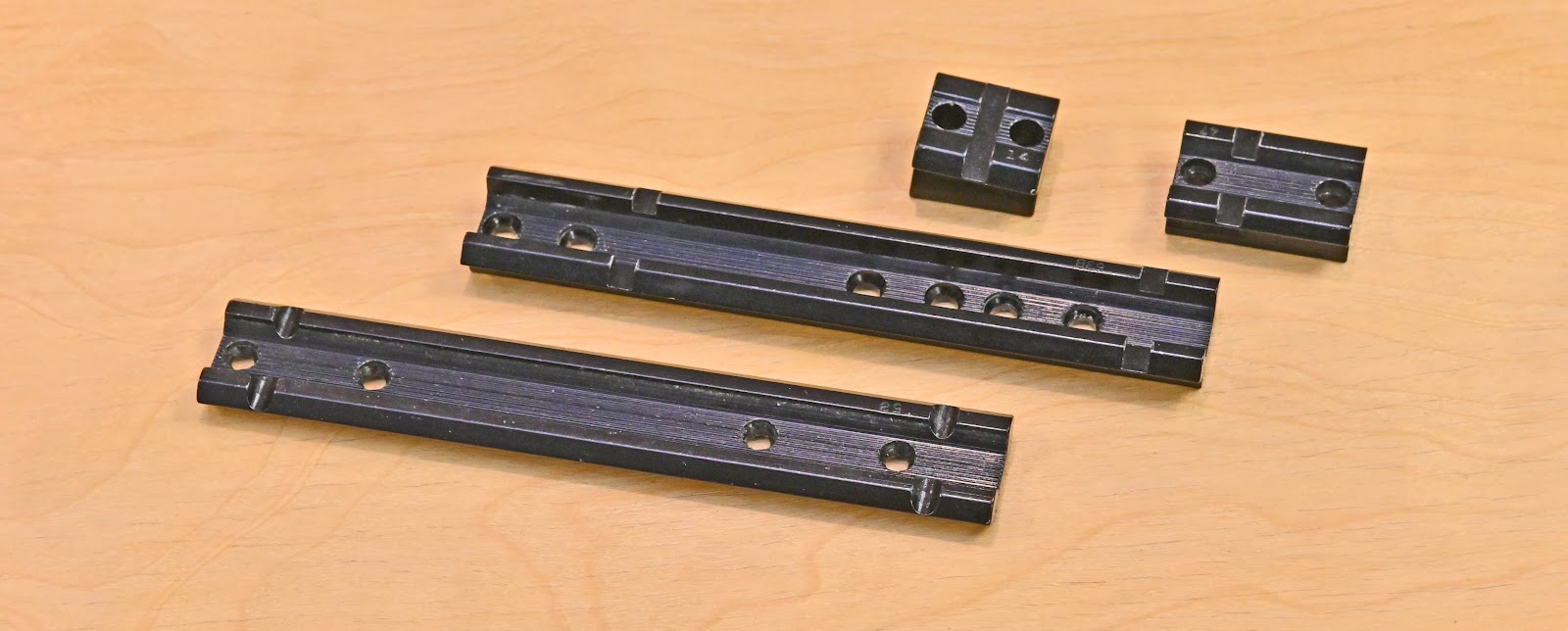
The Weaver rail system was state of the art in its day and is still often encountered, especially on older rifles.
PICATINNY RAILS
Recognizing the shortcomings of the Weaver rail but recognizing its potential, the US military set out to build something better. This resulted in the Picatinny rail, the name springing from the fact it was developed by the Picatinny Arsenal in New Jersey. Adopted into military use in 1995, it was designated as "MIL-STD-1913," with its NATO designation becoming "STANAG 4694 Accessory Rail." Often called a "Pic" rail or a "1913" rail, it has well-defined dimensions for all aspects. The slots, for example, are 0.206 inches wide and 0.394 inches center to center. The flexibility, standardization, and improved strength served the military's needs much better than any previous system.
As the NATO name suggests, it was originally designed to serve as a rail for optic mounting and as a means of mounting accessories, like lights and lasers, onto firearms. Its early use did indeed see this kind of application, but this has now largely been replaced by the M-LOK system, a design superior for most types of accessory mounting. And if a Pic rail is needed to mount an accessory, it can still be added using the M-LOK system. A good example is bipod mounting, where the Pic rail has some application. This is completely different from the Weaver system, which has never seen any wide use for accessory mounting.
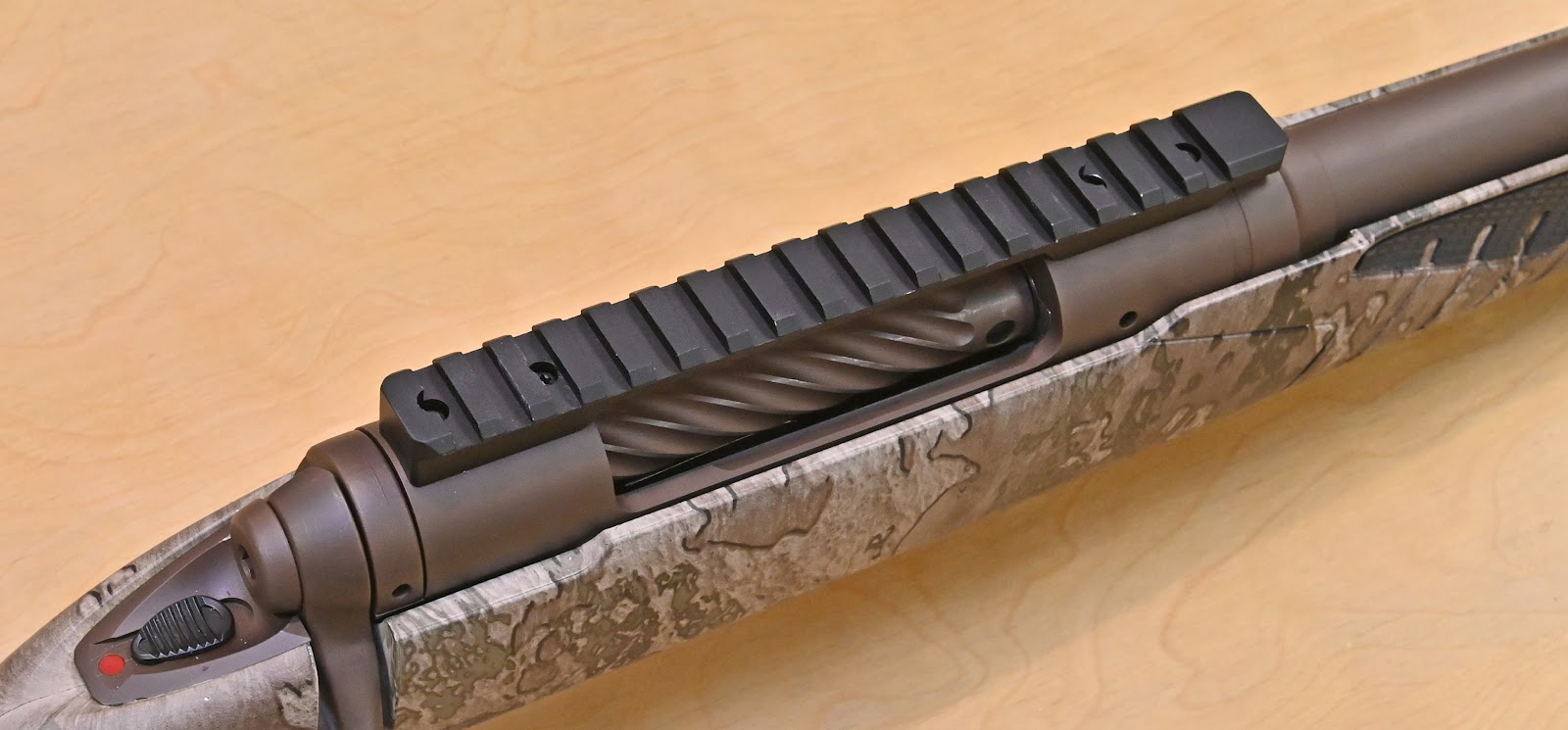
The Picatinny rail system is widely used in both civilian and military environments.
As with many military developments, the Picatinny rail found its way to the civilian world and is now the default standard for virtually all mounting of optics to rifles. A good example is the last air rifle I bought, which has an integral Picatinny rail machined into the receiver. For kicks, I measured the dimensions to see how close they are to the standard, and as far as I can tell, they are bang on.
CROSS COMPATIBILITY
This is a good place to take a side trip into the cross-compatibility of the two systems. It's a common issue because the two rails have quite similar profiles. The bottom line is that Weaver rings will often fit on a Picatinny rail, but Picatinny rings won't fit on a Weaver rail. This discrepancy exists largely because the tolerances of the Weaver system are so much looser than for the Picatinny system. However, just because a Weaver ring might fit on a Picatinny base doesn't make it a good idea. There can be issues. For example, the ill-fitting ring may not be centered over the rifle's bore, and this will cause serious issues at longer ranges. Additionally, it's common to see the bottom of a Weaver ring not supported by the top of a Picatinny rail. The image below shows the kind of gap that results in a loss of strength and stability that can exist in the mismatch. Yes, it "fits," but it's a poor fit and should be avoided.

Weaver system rings will attach to a Picatinny base as shown here, but it's often a poor fit, sacrificing strength and rigidity.
And to wrap things up I'll just add a caution to beware of offshore manufactured rings and bases which are poor quality. These products are all over the internet, and quality is always suspect. A recent set of rings I saw demonstrate this well, as the buyer didn't pay much and got exactly that amount of quality.
ARTICLES FROM AL VOTH
- Common Shooting Myths
- Rimfire Season
- Optics: Parallax and Optical Center
- Optics: Understanding the Optical Triangle
- The Ethical Shot
- Avoid Common Gun Mistakes
- Hunting Drills for Success
- Pursuing Precision
- Rimfire Season
ABOUT THE AUTHOR
Al Voth calls himself a "student of the gun." Retired from a 35-year career in law enforcement, including nine years on an Emergency Response Team, he now works as an editor, freelance writer, and photographer, in addition to keeping active as a consultant in the field he most recently left behind—forensic firearm examination. He is a court-qualified expert in that forensic discipline, having worked in that capacity in three countries. These days, when he's not working, you'll likely find him hunting varmints and predators (the 4-legged variety).
Related Posts

Fieldcraft: Three Tips for Predator Hunting

Long-Range Shooting Isn’t About Skill—It’s About Processes

Coyote Clint: 22 ARC Ruger American Ranch Field Stock Build

I Was Wrong About .22 Creedmoor

Hunt Fish Shoot - NEW Bergara Competition Elite! The Ultimate PRS Production Rifle?

Modern Day Sniper: The Real 6 Principles of Marksmanship

HOW TO ZERO A CLIP-ON THERMAL IN THREE SHOTS


