












It seems that in our relatively tight-knit firearms industry, thoughts travel fast. In the early 2000’s short fat magnum cartridges, such as the Winchester Short Magnum (WSM) and Remington Short Action Ultra Magnum (RSAUM) series, were all the rage. Just before 2010, the ballistic Zeitgeist shifted from chasing more velocity towards greater projectile efficiency. This took the form of longer, sleeker bullets with higher ballistic coefficients. This was evident with some of the cartridges being released or promoted at that time. These were the early years for cartridges like the 6.5 Creedmoor and the 6.5 Grendel. Both of these cartridges were low-recoiling and utilised projectiles with B.C.s rivalling those of bullets usually fired from much larger magnum cartridges.
There was a lot of talk from ballisticians such as Bryan Litz of Berger bullets about the importance of bullet aerodynamics. At this time, rangefinders were becoming increasingly prevalent, and the average shooter was better able to get an accurate range to the target. Given this diminished range uncertainty, the most difficult factor to contend with on an extended range shot became the wind, and the best way to beat the wind at long range is with slippery bullets.
If you’re curious, you can check for yourself. First, select a cartridge. For this example, I will use the new 22 ARC. Then select two different projectile loadings in a reloading manual for that cartridge. (Or in this case, I went to Midway USA and looked up the specifics for two separate factory loadings.) One load should have a lighter projectile that can be pushed faster, and the second load should be a slower, but more ballistically efficient projectile. For an apples-to-apples comparison, it’s best to use the same line of projectile in two different weights, i.e the Hornady Eld-M in this case. Record the anticipated velocity of both loadings, then run the ballistic calculations given their respective velocities and ballistic coefficients. Look at their drop and drift at 1000 yards(See table below)
| Projectile | Velocity | Ballistic Coefficient | Drop @ 1K yd | 10mph drift @ 1K |
|---|---|---|---|---|
| .75gr Eld-M | 3075 FPS | .467 (G1) | 294.1 (in) | 88 (in) |
| 88 gr Eld-M | 2820 FPS | .545 (G1) | 322.8 (in) | 80.8 (in) |
As you can see, the heavier, more aerodynamic bullet drifts 7 inches less in the wind. In some cases, the slower, sleeker bullet will even have less drop at 1000 yards. It would seem that the heavier, more aerodynamic bullet is simply the better choice, but this table doesn’t tell the whole story.
In fact, there are some situations where a lighter bullet would be more desirable than a heavier, sleeker one. Those mainly revolve around practical applications with the rifle rather than highly controlled, contrived rifle matches. The gains seen from a lighter bullet revolve around the fact that since they are lighter, they can be pushed faster out of the muzzle. Yes, it is the case that the lighter, lower B.C bullet will lose velocity faster than a heavier, sleeker one, but often that can be quite a ways down the road. Perhaps that distance is even greater than the shooter plans on engaging targets, and the benefits at short and midranges are worth giving up performance at the back end of the curve. At this point, I should also mention, for the sake of comparisons, we will only be talking about changing bullet weight within a given cartridge, not necking down a cartridge to a smaller diameter to use a lighter bullet that may still have a higher B.C than a heavier one in the next bore size up. (Although that does sound like a good way to go, my preference for the 7mm-08 over the 308 will have to wait for another day.)
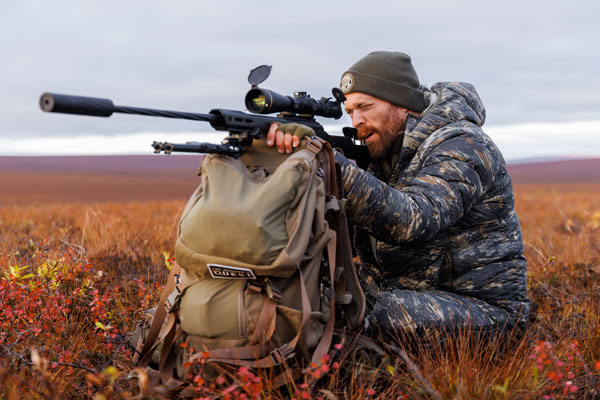
Advantage 1 is reduced recoil. Yes, a lighter recoiling rifle is more comfortable to shoot, but more important than shooter comfort is the ability to maintain a quality sight picture immediately after the shot. By respecting Newton’s third law of motion (for every action there is an equal and opposite reaction) and choosing a lighter recoiling projectile, we can better spot our own hits and misses and make the appropriate corrections. In addition to the effect recoil has on the shooter, there is also an effect on the rifle. More recoil increases the likelihood that the rifle will move off target during the bullet’s travel down the barrel, leading to larger groups downrange.
The second, and in my opinion, the greatest advantage of shooting lighter, faster projectiles is the flatter trajectory. Although I am very familiar with ballistic tables, this fact became most evident to me during a recent NRL hunter competition. Instead of shooting the 6.5 Creedmoor I am very accustomed to, I shot my custom wildcat 25x55 AI cartridge. This represented a change in muzzle velocity from around 2650 FPS to 3050 FPS, which meant a significantly flatter trajectory. Granted, the 25 caliber bullet is also more aerodynamic, so even at the same velocity, the trajectories would be slightly flatter, but I have found this rule of thumb to be true: inside 500 yards, the trajectory curve is primarily driven by velocity, not ballistic coefficient. So, instead of a 1/10mil (one click on my scope) representing 10 yards greater trajectory, that same one click pushed my point of impact out 15 yards.
I can already hear the armchair ballisticians and gear nerds yelling at their screens. “Why should I care about sweeping an area of 15 yards instead of 10 with a single click on my scope?” “I just point my rangefinder at the target and hit the button. I put the red circle on top of the target and get a number. I enter that number into my phone or Kestrel (ballistic solver), then I will just dial what the solver says. It’s that simple” Yes, rangefinders with +/- 1 yard of accuracy are readily available these days. However, that hyper-accurate distance might not be to the object you were trying to range. Factors like beam divergence and software come into play, but let’s save that topic for another day and for now, focus on the consequences of getting an incorrect range and how increased velocity helps to mitigate them.
Imagine, if you will, you are shooting a precision rifle match, and there’s a 10-inch steel target on a t-post out in the field in front of you. You bust out that hyper-accurate rangefinder and get a reading of 520 yards. Unfortunately, due to beam divergence or misalignment between the rangefinder's reticle and its beam, your rangefinder gave you that reading based on a tree that was 20 yards behind your target. If you were shooting the slower 88-grain bullet from the table above, you would miss the target completely off the bottom side, while the 75-grain bullet, travelling faster, would impact at 6 o’clock.
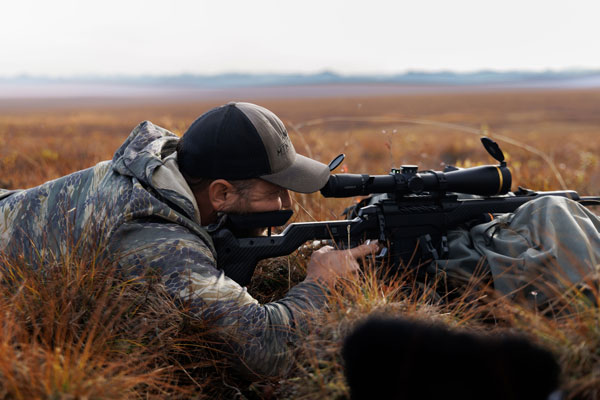
How about a more dynamic situation? You are out coyote hunting. You have your spot picked out, have done your prep work and made a solid range card. You have good ranges to various known points. After your prep work is done, you blast the call. Just a few minutes later, a lone dog shows up. He seems a little wary, but is zigzagging in towards the call. Knowing that you won’t be able to get him in nice and close, you decide to take your shot after he crosses the fence that is 350 yards away. You pre-dial your dope on your elevation turret and wait. Sure enough, just as planned, he ducks under the fence, and you take your shot. Unfortunately, it impacts the dirt just in front of him. Having been shot at before, he knows he needs to get the heck out of there, so he takes off running. As you line up for your second shot, you think to yourself, he’s over 50 yards further by now, so you hold a half mil high. The good news is you’re shooting the lighter/faster bullet, and your .5 mil hold is good on his 6-inch chest cavity, anywhere from 390 yards all the way out to 440 yards. So, when you break your follow-up shot after he has already scrambled out 430 yards, it piles him up. Whereas if you were shooting the slower projectile, your window on that same 6-inch target would be 395 to 425. That is 20 yards less margin for error in range estimation on the fly. If you are like me, you’ll take all the help you can get when it comes to swagging ranges.
To wrap it all up. I don’t think folks were wrong back in the early 2010s when high Ballistic Coefficients and fast twist barrels were becoming the new hotness. In fact, I fully agree that in our current era of long-range shooting, the most difficult variable to contend with is the wind, and nothing beats the wind like aerodynamics. Even with added velocity, it is tough to outrun the wind with a lighter bullet from the same casing. However, most of us are not trying to punch out the X-ring at a 1000-yard F-Class match, and maybe we are not shooting 20 lb rifles at stationary targets where the range to target has been provided by a generous match director. As shooters, we need to be rational, objective and specific regarding what we are trying to achieve on the day. In situations where range uncertainty remains a factor, a little extra speed can make all the difference.
ABOUT THE AUTHOR
Marcus Hom is a shooter through and through. Born to a pistol-packin mama, he has spent his entire life around firearms. Marcus spent much of his adulthood guiding hunts in Alaska, teaching CCW and precision rifle courses, competing in national-level matches, conducting research and development, and gunsmithing. Marcus is a former Federal Law Enforcement Officer.